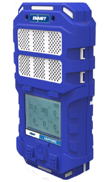
Highlighting the superior design features of SAP-PHIRE
are the exclusive, interchangeable, Pre-Calibrated,
SMART SENSOR MODULES. These interchangeable modules
are available for detection of VOCs, % LEL hydrocarbons,
CO2, H2, O2, CO, H2S, SO2, NO, NO2, and other
toxic gases. The choice of electrochemical, IR,
PID and MOS sensors facilitates selection of the
best technology for each application. Up to 27
sensors are available or in de-velopment.
Having 6 sensor positions available, SAPHIRE can
monitor and display up to 8 gases when utilizing
the combo CO/H2S, and infrared CO2/CH4 sensors.
SAPPHIRE includes audio, visual and vibratory
alarm indicators. The lithium-ion battery provides
long operating life and fast recharge times. SAP-PHIRE
is not only SMART and easy to use, it is also
very robust. Intended for rugged service in harsh
environments, the enclosure is constructed of
ther-moplastic rubber coated polycarbonate.
FEATURES
- Smart,
Pre-calibrated, Interchangeable Sensor Modules
-
Monitors Up to 8 Gases if CO/H2S and CO2/CH4
Sensors Are Utilized
-
Simultaneously Displays Data for 6 Channels
of Gas
-
Sensor Options: Electrochemical, Catalytic,
MOS, IR & PID
-
High Resolution Backlit LCD
-
Encapsulated, Water-Proof Construction, with
High Ingress Protection
-
Modular Battery Housing Can Be Charged Separately
from Instrument for Spare Battery with up to
40 Hours Operating Time
-
Rapid Charging Function—Battery Module
Can be Charged in 5 Hours
-
Confidence Chirp During Normal Operation
-
Lithium Battery Standard. Can Operate on Optional
NiMH, or Alkaline Battery
-
Can Be Charged Direct with Cable or Charging
Base
-
Powerful Networking and GPS Positioning Function
-
Large Memory for Up to 3 Months of Data Storage
-
Low Battery Indication
-
Multi-level Filtration System extends Vacuum
Sampling Pump Life
-
Self-Test Function
-
Two Instant Alarm Points
-
STEL and TWA Alarms for Toxic Gases
-
Over-range Gas Alarm
-
Audio, Visual LED and Vibratory Indicators
-
Available for CO, H2S, NH3, SO2, H2, O2, etc.,
Combustible Gases, CO2 and VOC’s
-
Designed to be Intrinsically Safe
SAPPHIRE SENSOR TECHNOLOGY
(IR)
Sensors:
The infrared sensor is offered for CO2 and hydrocarbons.
The level of CO2 can be from low ppm to % by volume
concentrations. The range for hydrocarbons is
generally 0-100% LEL. In addition to methane,
propane is offered for detection of other typical
hydrocarbons. The IR sensor utilizes an infrared
light source of a certain wavelength that is highly
absorbed by the gas to be monitored. In the process,
the infrared light is passed through the gas in
the sample chamber. The target gas absorbs the
select wavelength proportional to the gas concentration,
which is measured and displayed. Different wavelengths
are used for CO2 versus hydrocarbons so there
is no cross sensi-tivity between these two applications.
IR sensors can be used to measure hydrocarbons
in an inert environment. Water vapor and corrosive
gases, such as H2S, are to be avoided.
Electrochemical (EC) Sensors:
Electrochemical sensors are used primarily for
detection of inorganic gases, CO, H2S, SO2, etc.
These sensors consist of electrodes, electrolyte
and air/liquid separation barrier. Gas molecules
enter the cell and, as a result of an oxidation/reduction
reaction, generate an electrical current proportional
to the gas concentration. Unlike MOS and PID sensors,
EC sensors are quite specific, but some cross
sensitivity to other similar gases generally exists.
Metal Oxide Semiconductor (MOS) Sensors:
An MOS sensor consists of a heated bead composed
of mixed metal oxides that decrease in resistance
in the presence of many different gases and vapors.
These sensors are used for the detection of various
hydrocarbons and organic solvents at ppm or percent
LEL levels. They can be optimized and calibrated
for a particular gas or group of gases, but they
are inherently non-specific. High humidity conditions
can result in higher upscale read-ings, while
extremely dry conditions have the reverse effect.
Photoionization Detector (PID):
The PID sensor utilizes a UV lamp to produce high-energy
radiation which reacts with the sample gas to
generate a measurable flow of charged particles,
the process known as photoionization. While lamps
of different energy levels are available, 10.6
eV is the most common. Various gases have different
Ionization Potentials. A 10.6 eV PID can detect
those gases having an IP of less than 10.6 eV.
The PID is used for ppm or even ppb levels of
VOC’s. Like the MOS, PID sensors are very
non-specific, as defined by the energy level of
the UV lamp and the IP of the gases present. Water
vapor will suppress readings, and corrosive gases,
such as H2S, can damage the sensor.
Catalytic (CAT) LEL Sensors:
Catalytic sensors are used to detect combustible
hydrocarbons in the range of 0-100% LEL. Within
this definition, these sensors are completely
non-specific, however, their proper application
depends upon the level of cross sen-sitivity response
and the 100% LEL concentration for different gases.
Methane is the most common calibration gas, but
propane and other gases are used for other applications.
The sensor consists of a pair of elements, one
active and the other a reference bead, which are
connected to a classic “Wheatstone Bridge”.
The active and ref-erence elements create an electrical
signal proportional to the gas concentration.
Catalytic sensors are subject to silicone poisoning
and the corrosive effects of certain gases.
SAPPHIRE
Instrument Specifications
Sampling Method: Diffusion or optional pump
Operating Temperature: +5 to +122°F (-15 to
+50°C)
Storage Temperature, Short-Term: -22 to 158°F
(-30 to +70°C)
Operating Humidity: 15 to 90% rH, non-condensing
Ingress Protection: Designed for IP66-IP67
Size: 6.8 x 3.7 x 1.4 inches (172 x 93 x 36 mm)
Weight: 1.3 lbs (600g)
Enclosure: Thermoplastic rubber coated polycarbonate
Display: LCD Matrix, 200 x 140
Battery Charge Time: 5 hours
Battery Operation Life: 40 hours
Battery Capacity: 6600 mAh
Battery Type: Lithium-ion, #18650, 3.7V, 2200
mAh, 3 cells
SAPPHIRE
Sensor Information
Types of SMART, Pre-calibrated, Interchangeable
Sensors:
Electrochemical (EC) - Infrared (IR)
Combo CO/H2S (EC) - Combo CO2/CH4 (IR)
Photoionization (PID) 10.6 eV - Metal oxide semiconductor
(MOS)
Catalytic (CAT)
Total Sensor Positions: 6
Maximum High Energy Sensors: 2
Sensor Energy Rating Based on Power Consumption:
EC: Low; EC Combo: Low; CAT: High; IR: High IR
Combo: High; PID: High; MOS: High
Maximum Number (6 Total) of Installed Sensors
at the Same Time, by Energy Rating:
6 low energy sensors (EC and EC combo)
2 high energy sensors (CAT, MOS, PID, IR &
IR Combo)
4 low energy and 2 high energy
Maximum Gases Monitored: 8, using 2 combo sensors
Maximum Gases Displayed: 8, 4 constant, 4 alternating
with 2 combo sensors
SAPPHIRE
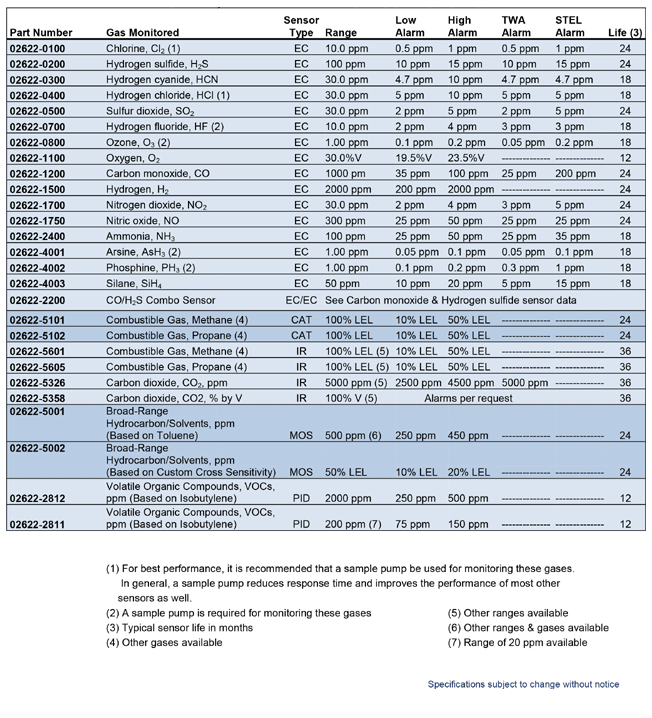
SENSOR TABLE
SMART, PRE-CALIBRATED SENSOR MODULES
|